
Quincy Resident Lookup Records
A name match needs context. The Quincy Assessors viewer can tie a name to an assessed parcel, while the Norfolk Registry can document a recorded transfer. MassCourts can locate a public case entry, and the voter-status form is only an individual confirmation tool. Vital and probate material may establish a family event or an estate relationship, but access rules differ. Use the source that answers the exact question, then add a separate record with its own date and keeper.
| Record | What It Can Confirm | Quincy or State Keeper | Access Route |
|---|---|---|---|
| Assessor parcel card | Assessed owner, situs, mailing address, and parcel facts | Quincy Assessors | VGSI property viewer; office fallback |
| Recorded land document | Transfer parties, date, and legal description | Norfolk Registry of Deeds | Registry and Land Court search |
| Voter-status result | One person's registration match and ZIP | Secretary of the Commonwealth | Individual voter-status form |
| Court docket | Public case identity, events, and disposition | Applicable Massachusetts court | MassCourts, kiosk, or clerk |
| Vital or probate record | A legally defined event, heirs, or estate role | RVRS or Norfolk Probate and Family Court | Eligibility route, archive, portal, or clerk |
| Library and obituary material | Dated family, address, or community context | Thomas Crane Archives | Appointment and research assistance |
For a Quincy resident lookup with an address in hand, begin with the parcel card and distinguish the situs from the tax-bill mailing address. With only a name, test plausible spelling variants in the court and state indexes, then seek a second, independent source. A mailing address or officer address is a lead, not proof that the person lives there.
Note: Record the exact spelling, source date, and whether a field describes an owner, party, applicant, or historical resident before comparing results.
Verify a Quincy Resident Match
The right-person problem is common in Quincy, particularly when a name has initials, a former surname, or several local matches. Build a two- or three-factor match from independent records. A parcel, a deed, a court location, a dated obituary, or a known relative can supply those factors. Do not merge records merely because a surname and city line up. The assessor identifies the assessed owner, and the Registry identifies recorded parties, which are different facts.
- Start with a dated public record that fits the question. For an ownership question, search the Quincy assessor by owner or address and note the MBLU, PID, situs, and deed reference.
- Check the recorded document in both the Registry and Land Court paths. Compare the party name, legal description, book and page or instrument number, and recording date.
- Use MassCourts only for a specific public case question. Select the court department and location, then try sensible name and initial variants.
- When an official copy is needed, ask the filing custodian for the document type and its copy or certification process rather than relying on a search result alone.
- Docket
- A court's running list of a case's filings, events, and orders. It is not the same as every document in the court file.
- Index and image
- An index points to a record. An image is the scanned document itself, when the keeper makes it available.
- Certified copy
- A copy issued by the custodian with its official certification for a purpose that requires one.
Quincy has a useful local complication: a Registry search can miss a title held in the separate Land Court system. A recorded-land result that goes cold should be checked against the Land Court owner or certificate route before concluding that the trail ends.
Quincy Resident Court Searches
Massachusetts Trial Court Case Access begins with a court department, then may require a division and location. Its public interface offers Name, Case Type, Case Number, and Ticket or Citation Number paths. For a Quincy matter, select the court that serves the person or case rather than treating a statewide name result as conclusive. Quincy District Court, Norfolk Superior Court, and Norfolk Probate and Family Court have different files and rules.
A public result may show a party name and role, case number, court placement, filing date, type, events, hearing dates, status, and disposition. Those fields vary by department and access level. The public internet portal is not the only channel. The clerk counter and the courthouse public computer kiosk remain important when a visible result does not include the needed public document.
- Search party-name spelling and initial variants.
- Keep the case number and court location with every result.
- Ask the clerk for a named document, not an unlimited file search.
- Expect sealed, impounded, juvenile, adoption, and other protected material to be unavailable.
Note: A public docket can establish that a public case entry exists, but it does not supply a complete account of a person's life or identity.
Quincy Resident Voter Check
The Secretary of the Commonwealth's voter-status form is designed for the individual voter. It requires first name, last name, month, day, year of birth, and the five-digit residential ZIP, plus an agreement checkbox. A match can confirm registration information for that person. It is not a public browse of names on a Quincy block or street.
Massachusetts law makes central voter names and addresses non-public as an ordinary record under M.G.L. c. 51, § 47C. A no-match can reflect a ZIP mismatch, a move, spelling, maintenance status, or protected registration. For dated historical work, Thomas Crane collections and State Library voting-list holdings are better suited to old adult-resident lists than a modern status form.
Quincy Resident Vital Routes
For a Quincy birth, marriage, or death, ask the City Clerk or local registrar whether the event is held locally and what proof is required. The Registry of Vital Records and Statistics order route is the statewide alternative. RVRS holds records from 1936 forward, while the Massachusetts State Archives holds the 1841 through 1935 genealogical range. RVRS research is in person rather than a public online name index.
Newer certificates have relationship, tangible-interest, official-duty, or court-order limits. Birth and marriage records older than 90 years, and death records older than 50 years, are generally outside the ordinary confidential-period restriction. A divorce case file belongs with the Probate and Family Court that handled it, not RVRS. Treat an index lead and a certified copy as different levels of evidence.
Note: A Quincy vital-record lead identifies the next custodian, while a certified copy has separate eligibility and issuance rules.
Quincy Resident Birth-Record Path
Massachusetts has a defined route for certain pre-adoption birth records. An adult adoptee born in Massachusetts, certain adult children of a deceased adoptee, a parent or legal guardian in the listed circumstances, and an adoptive parent of a minor may apply without first obtaining a court order. Other applicants need a certified Massachusetts Probate and Family Court order under M.G.L. c. 46, § 13(h).
This route can answer a family-history question through the proper custodian. It does not turn the broader vital-record system into a name-search directory. If eligibility is unclear, use the official RVRS instructions or the court clerk instead of assuming that an old family reference gives access.
Quincy Resident Affiliation Records
The Massachusetts Corporations Division search accepts entity name, individual officer or director name, identification number, or filing number. A filing can provide an entity's legal name, officers or managers, registered agent, principal office, filing dates, and images. It can help separate people with the same name or identify a dated connection to an organization, but an agent or office address does not prove a personal address.
Use the visible search mode as a starting point, then preserve the entity name and filing date with the result. The state's professional-license search can similarly confirm a license identity, type, status, and location field without establishing where someone lives.
Quincy Resident Record Requests
When an existing Quincy or Massachusetts record is not online, the Massachusetts Public Records Law request process can be the fallback. M.G.L. c. 66, § 10 and 950 CMR 32.00 call for a written request that reasonably describes an existing record, provides a date range, and asks for electronic delivery when useful. A custodian normally responds within 10 business days with an offer, clarification, partial production, or a denial citing an exemption.
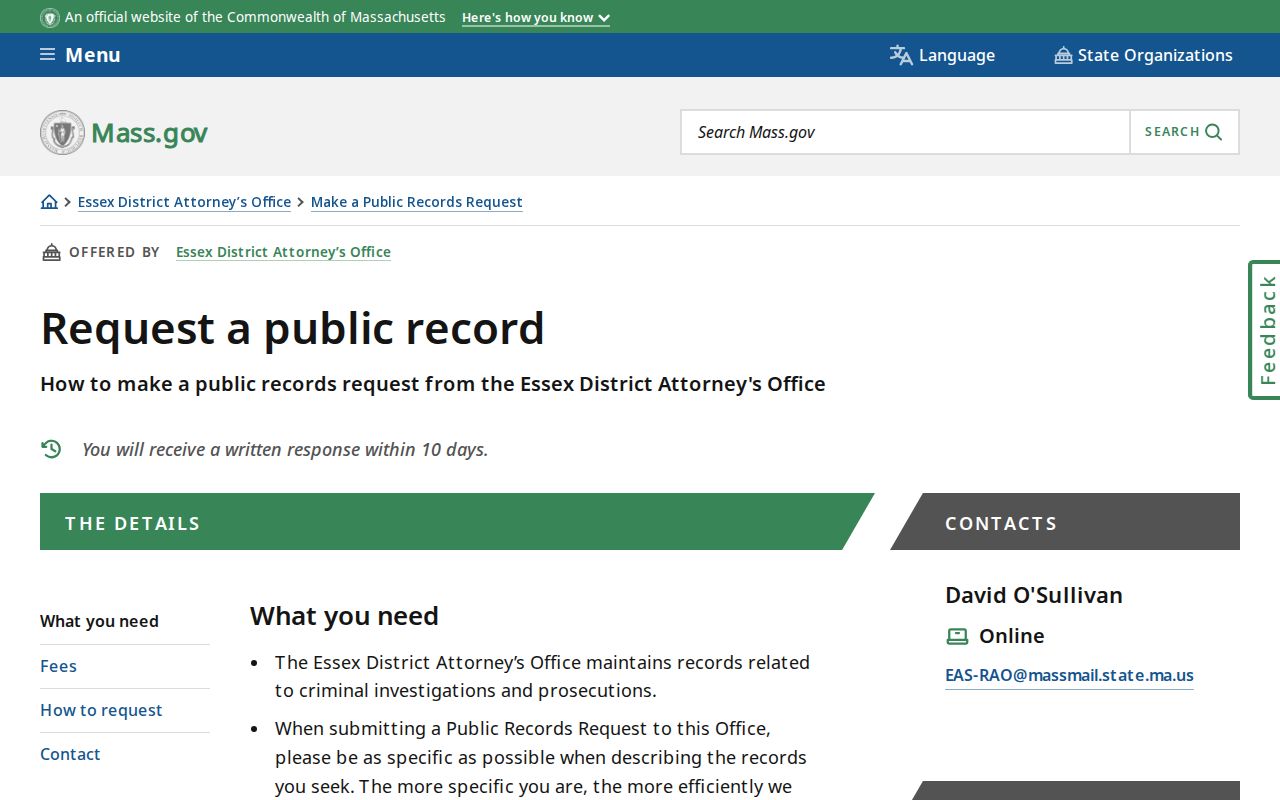
Ask the relevant assessor, court clerk, election office, or city department for the specific record type, address or case number, and time period. Electronic copies generally avoid a copying fee, while permitted copying, postage, and labor charges are limited by law and regulation. A request cannot require an office to create a new resident list or disclose a protected address.
Note: A narrow record request is easier for a custodian to identify and more likely to produce a useful answer than a broad name-only demand.
Quincy Resident Custody Checks
For a current state-prison custody question, Massachusetts directs the public to VINELink, using a full name or commitment number. The official guidance also gives a telephone option. A Norfolk County public jail-roster search was not located in the reviewed official sources, so the Sheriff is the custodian fallback for a specific custody question.
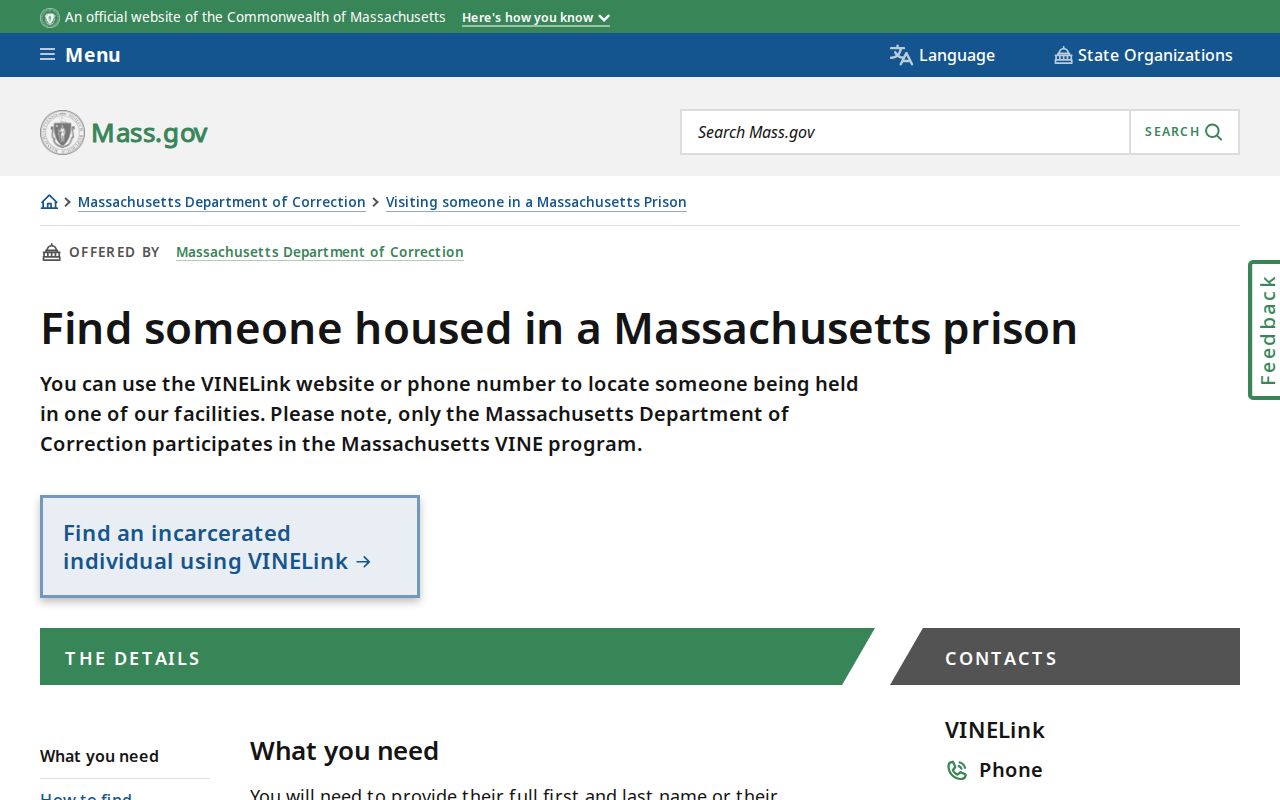
A custody notification result is not an address record and should not be used to infer a current Quincy residence. Timing, spelling, transfer, release, and confidential records can affect a result. For a public court record, use the court docket and clerk channels described above.
Quincy Resident Privacy Limits
Some Quincy records are public while others are deliberately limited. The Massachusetts Address Confidentiality Program provides eligible survivors and certain protected-health-care professionals with a substitute address and mail forwarding under M.G.L. c. 9A and 950 CMR 130.00. Central voter addresses, RMV personal information, sealed or impounded files, and sensitive vital information have separate safeguards. A record's absence can reflect a legal restriction rather than an error.
Ask the office that holds a wrong record about its correction, redaction, appeal, or impoundment process. Do not republish Social Security numbers, financial identifiers, protected addresses, or unnecessary victim information from a record. A dated official source is more reliable than a private compilation that can be stale or merge similar names.
Lawful use. Quincy resident research is for personal, lawful purposes such as family history, estate questions, and record verification. Massachusetts law prohibits stalking and criminal harassment.