
Quincy City Directory Collections and Shelves
Quincy's printed collections survive in several overlapping series, not one seamless annual set. The earliest verified run begins with Gibson and Morrison volumes issued from 1855-56 through 1866. Root's Quincy City Directory follows in 1868-69, 1869-70, 1871-72, and 1873-74, while the Langdon and Arntzen reference book also covers 1873-74. Later catalog and local citations extend across much of the twentieth century. The Thomas Crane Archives & Special Collections, the Massachusetts State Library holdings, and catalog leads at genealogy repositories each supply part of the shelf.
| Quincy collection | Verified years | Where held | How to use it |
|---|---|---|---|
| Gibson and Morrison early directories | 1855-56 through 1866, selected years | Historical Society citations; ask Thomas Crane or the Society for shelf access | Early names, streets, trades, and business context |
| Root's Quincy City Directory | 1868-69, 1869-70, 1871-72, 1873-74 | Thomas Crane, State Library, and FamilySearch catalog leads | Name, occupation, and address leads |
| State Library Quincy directory run | Selected 1868-69 through 1967 volumes | Massachusetts State Library holdings | Long-run household and street tracing; some listed formats are microfilm |
| Adult-inhabitant and voting lists | 1928-40 and selected 1942-99 years | Thomas Crane, State Library, Internet Archive, and FamilySearch catalog leads | Adult residents by name or street, under rules different from commercial directories |
| House-guide directories | Selected 1922-67 years | State Library catalog | Address-to-occupant leads, then confirm in the name section |
Gaps in the identified holdings are real gaps in this documented picture, not proof that no volume was printed or survives elsewhere. The State Library list includes selected Quincy years through 1967, and other catalog leads reach selected years into the 1990s. Transcribe each volume's title page because publisher names change across the run. It is safer than calling every book a Polk directory when the sources instead verify Gibson and Morrison, Root, Langdon and Arntzen, later Quincy titles, and adult-inhabitant lists.
Quincy Directory Research at Thomas Crane
Thomas Crane Public Library is the main local fallback when a catalog link ends at a holding record. Its Archives & Special Collections are in the Richardson Building at 40 Washington Street and collect Quincy directories, annual reports, yearbooks, voting lists, newspapers, photographs, genealogy, and local authors. The materials are for in-library use. Quincy Room special collections are closed stacks and appointment-only, so an advance request helps staff bring the right years. A photo ID is held while materials are used; photography is allowed subject to copyright, while copying is at staff discretion.
The Archives and Special Collections page provides research assistance at qulocalhistory@ocln.org and 617-376-1436, and it accepts obituary requests by email. Begin an appointment request with the surname, street, likely years, and any neighborhood form found in a family paper. Staff can also point researchers to local newspapers, directories, and finding aids when the needed volume is not on an open shelf. That route is more useful than assuming a missing web scan means the directory does not exist.
Thomas Crane's online library also lists in-library access to American Ancestors, Ancestry Library Edition, and FamilySearch, plus access conditions for HeritageQuest and HeritageHub. Its newspaper paths include Patriot Ledger material, Quincy Sun coverage, and digitized Quincy titles. These related sources help test an address or surname found in a historical volume without turning one printed entry into a firm conclusion.
Thomas Crane's online-library page shows the genealogy and newspaper resources that support a local directory search.
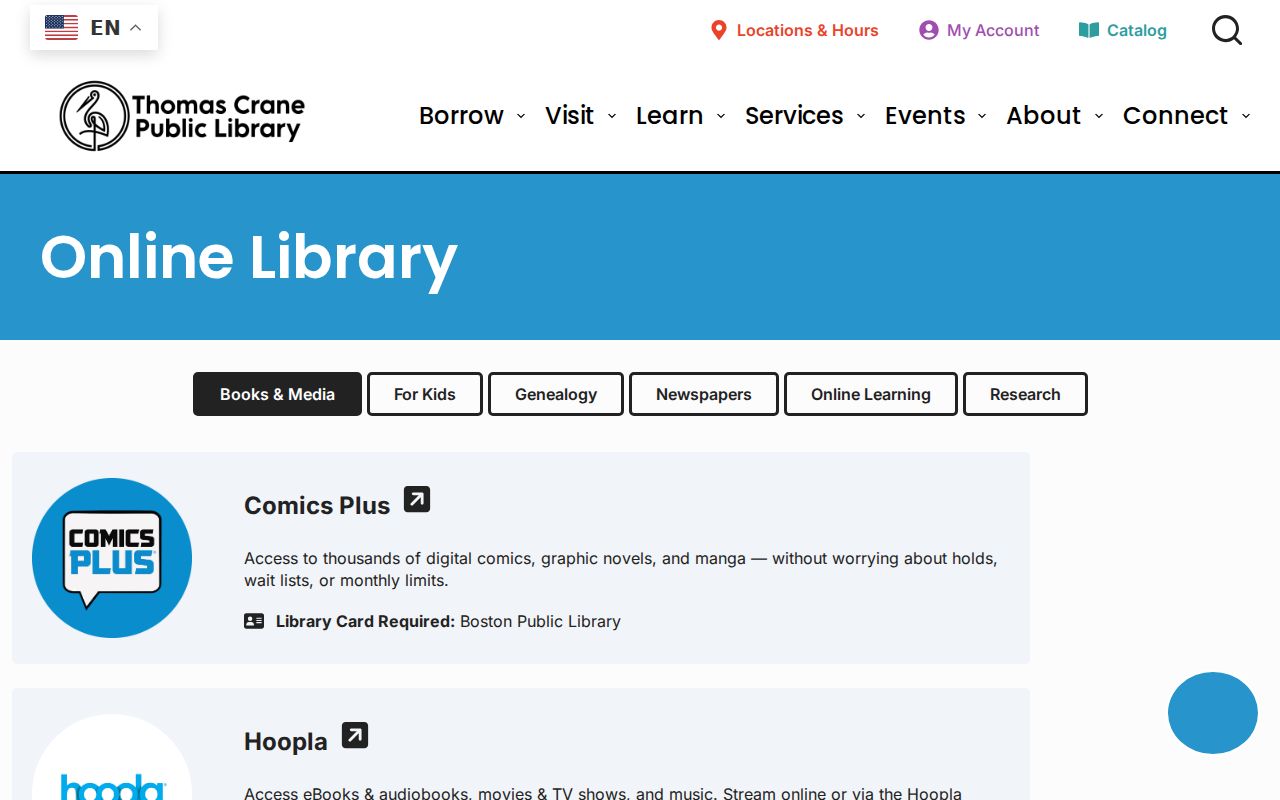
Those database access rules make a library card, an in-library session, or an appointment part of the research plan rather than an afterthought.
Quincy's Printed Directory Era
The directory record has a distinct local rhythm. Local citations identify Quincy directories for 1884-85, 1885-86, 1886-87, 1887-88, 1891-92, 1892-93, and 1896-1938, with 1894-95 absent from that cited run. A separate 1902-35 catalog lead offers broad annual or near-annual coverage, followed by selected mid-century volumes and selected 1964-86 directory years. The adult-inhabitant and voting-list series then adds another type of resident evidence. A year that is missing from one series may still be represented by another kind of list.
| 1855-56 to 1866 | Verified Gibson and Morrison early volumes establish the printed Quincy directory record. |
|---|---|
| 1868-74 | Root's identified volumes and the Langdon and Arntzen 1873-74 reference book add named series. |
| 1892-1938 | Local citations describe this long run, except 1894-95, for address and household continuity. |
| 1928-99 | Selected adult-inhabitant and voting lists supplement, rather than duplicate, directory volumes. |
Quincy's record trail reflects a city shaped by granite, rail connections, Fore River shipbuilding, and coastal neighborhoods. That history left records in printed directories, annual reports, newspapers, and historical collections rather than a single master file. The industrial story is useful because it explains why a household might be described through an address, a trade, a business place, a neighborhood, or a family connection in different sources. It does not turn an old entry into evidence about the present.
Note: Keep the precise year and title in every citation because Quincy series overlap and their publisher labels change.
How a Quincy Historical Directory Entry Reads
An entry normally starts with a surname and given name or initial, then adds the details the publisher chose to print. The residence address is the key field for a family or property trail, though a business address may be separate. A spouse or household note may follow the name, and a widow notation can help distinguish people with similar names. Historical occupation text is context for that publication year only. It should never be treated as a current fact. When a volume includes a house guide, read the key in that same book before deciding what any householder-status mark means.
| Name entry | Usually surname followed by a given name or initial; compare variants and punctuation. |
|---|---|
| Residence | Street and number for the listed person; a business address can appear separately. |
| Household clue | Spouse, relative, or widow notation may appear, depending on the year. |
| Historical context | Trade or affiliation may help separate same-name entries but is dated information. |
| House guide | A reverse street-and-number section that names an occupant or householder when included. |
- Criss-cross directory
- A directory arranged by street and house number rather than alphabetically by name. In Quincy, catalog notes call some later examples a House Guide.
- Householder index
- A name or address listing focused on the household contact, not a census of every person in the building.
- Abbreviation key
- The introductory explanation for symbols and shortened words. Photograph or transcribe it before interpreting a mark.
A directory is a publication snapshot. Children, boarders, recently moved people, and some other household members can be absent. A listing may also use a boardinghouse, institutional, or business address. Check the title-page key and compare two sources before drawing a family conclusion.
Quincy House Guides and Name Variants
House guides are the address side of the historical volumes. For selected 1922-67 directories, the State Library catalog notes a House Guide, which can move a search from a street and number to an occupant or householder and then back to the alphabetical name section. It is a historical address tool, not a modern street directory. The collections and their access details are handled by the local repositories, while current address-keyed records belong with the Quincy street directory workflow.
Search the printed form, not just the modern form. Quincy Center can appear as Quincy Centre, North Quincy can appear as Atlantic (No. Quincy), and Hough's Neck can appear without its apostrophe. Initials, married or widow variants, directional words, and shortened street names can also produce a false miss. Directory OCR and old handwriting add another layer of error. Capture the spelling exactly as printed, then test the alternate form in the next volume, newspaper, census, or deed trail.
Note: A house-guide result identifies a dated occupant or householder, not everyone who lived at that address.
Trace Quincy Families Across Volumes
Tracing a household works best as a dated sequence. Start from the oldest confirmed name or address, and preserve the street spelling, number, directory year, relative clue, and any historical context. Then work toward the next available book rather than inventing a continuous run. Quincy neighborhoods such as Quincy Center, Quincy Point, Germantown, Hough's Neck, Merrymount, Montclair, Norfolk Downs, North Quincy, Squantum, West Quincy, and Wollaston may appear as locality descriptors. A change in that label can describe the same city household, a move within Quincy, or an indexing choice, so the address and family details matter.
- Find the earliest confirmed name or address in a dated Quincy volume and record its spelling, number, year, and household detail.
- Check the house-guide or reverse section for the same street and number, then compare it with the alphabetical entry.
- Search the closest available years on both sides of a suspected move and mark any gap rather than filling it by assumption.
- Pair the directory with the 1900, 1910, 1920, 1930, 1940, or 1950 federal census when the dates line up. The 1950 census became public in 2022 under the 72-year rule.
- Use an obituary, deed, probate file, cemetery record, or newspaper item to account for a disappearance, death, move, or name variant.
Federal census schedules can test whether the listed head of household belongs to the expected family. They cannot cure every mismatch. A directory omission may reflect a recent move, a boarding arrangement, a different listing rule, or a gap in surviving access. Keep the source date beside every conclusion.
Quincy Directory Years with Newspaper Evidence
Thomas Crane's newspaper holdings are especially helpful between printed volumes. The library lists digitized Quincy Daily Ledger issues from 1890-1915, Quincy Monitor issues from 1886-98, and Quincy Patriot issues from 1837-1915. Patriot Ledger material is available through its listed database access and on microfilm from 1837 to current; Quincy Sun online coverage runs from September 1968 through December 2021, with microfilm from 1968 to current. Search names, dates, keywords, and combinations, then expect OCR to miss punctuation, initials, and unusual surnames.
A Thomas Crane Archives visit can connect those newspapers with yearbooks, obituary help, oral histories, and local images. A notice may give a date, street, school, civic group, funeral home, or family relationship that explains a directory change. It still needs a source citation and should not be read as proof of an ongoing address.
Thomas Crane's archive page describes the local-history and genealogy access that surrounds the historical shelf.
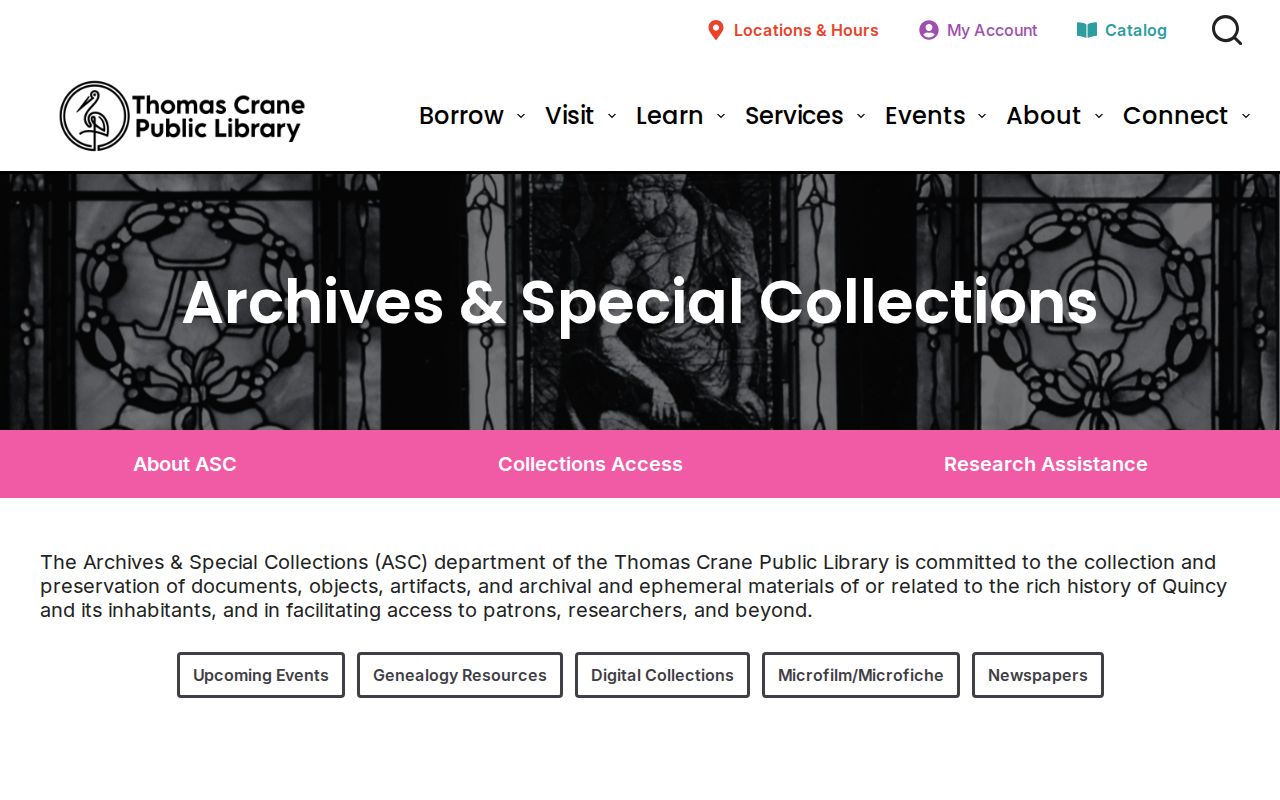
The appointment and in-library rules shown there are part of the access path for the older printed and microfilm records.
Quincy Historical Sources Beyond the Library
The Quincy Historical Society is another local research stop. Founded in 1893, it maintains a research library by appointment at 8 Adams Street and documents Quincy inhabitants, the Adams, Hancock, and Quincy families, granite, shipbuilding, and local architecture. Its collection is not a substitute for a directory run, but it can provide family papers, photographs, industrial context, or a local citation that points back to a printed volume. Contact the Society before relying on a web search alone.
The Quincy Historical Society explains its research-library role and collection focus. Its early-directory citations are important because the current web does not publish a complete Thomas Crane shelf inventory with every call number and publisher. Use the cited series and years as leads, ask the library or Society which copy can be consulted, and preserve gaps as gaps.
The Quincy Historical Society research-library page is the source for the collection and appointment context.
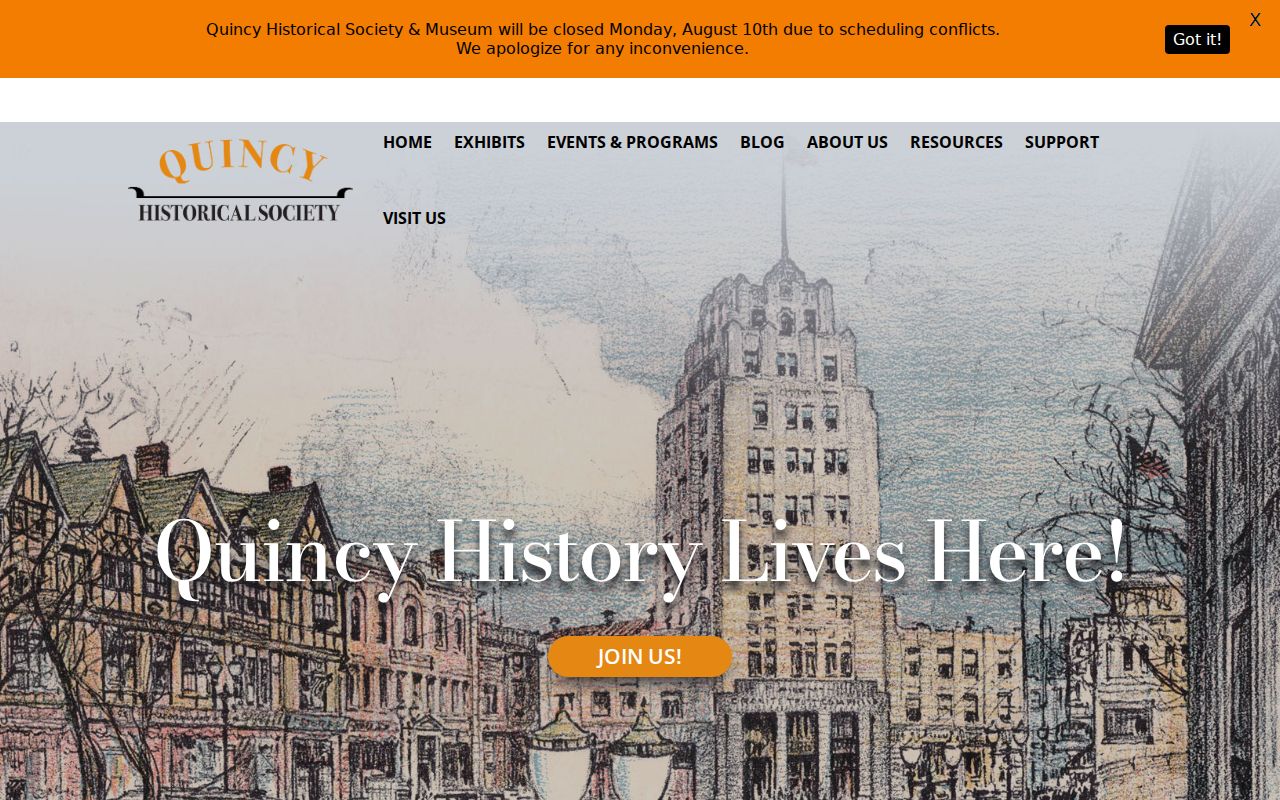
Its collections add manuscript and local-history context to the volumes without replacing their dated information.